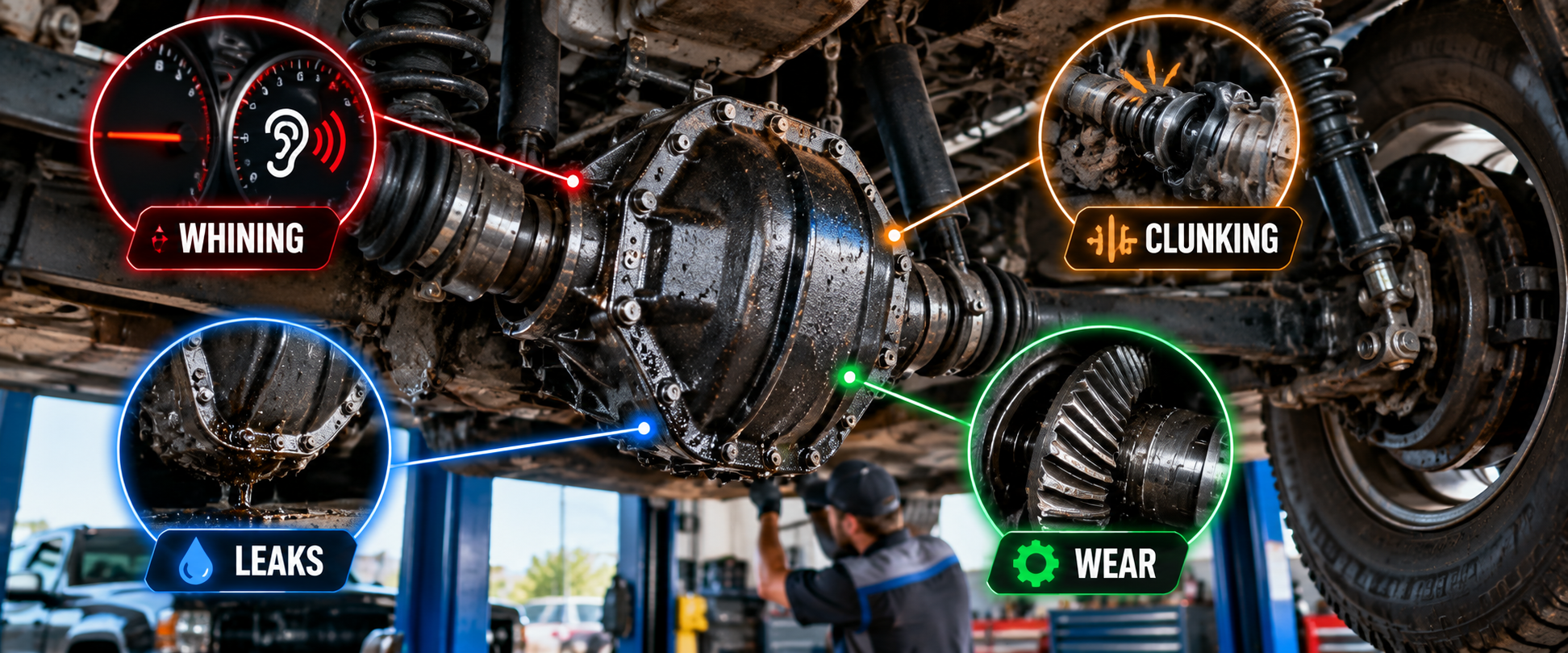
Most drivers never think about their differential until it starts making noise. Then it’s hard to think about anything else. A whine that rises with speed, a clunk when you let off the gas, or a chatter in tight parking lot turns can all point to a differential that needs attention.
At Pro-Tech Transmissions in Glendale, we diagnose and repair differentials on cars, trucks, and SUVs from across the West Valley. Here’s how to read what your differential is telling you, when it’s safe to keep driving, and what repair usually involves.
| Quick answer: The most common differential problems are a whine or howl that changes with speed, a whir only when decelerating, a rumble at highway speeds, clunking when accelerating or turning, chatter in tight turns, and gear oil leaks. Most start with worn or low gear oil and worn bearings. If you notice them early, a fluid service or bearing repair may be enough. Pro-Tech Transmissions offers a free diagnostic at 5408 W Camelback Rd #2, Glendale, AZ 85301. |
What Does a Differential Do?
When you turn a corner, your outside wheels travel farther than your inside wheels, so they need to spin faster. The differential lets them do that while still sending engine power to both. Without it, your tires would scrub and hop through every turn.
Where your differential lives depends on your vehicle:
- Rear-wheel-drive trucks and SUVs have a differential in the rear axle housing, the round “pumpkin” between the rear wheels.
- Front-wheel-drive cars have the differential built into the transaxle.
- 4×4 and all-wheel-drive vehicles usually have both a front and a rear differential, plus a transfer case that splits power between them.
Each differential is filled with thick gear oil that lubricates and cools the gears and bearings. When that oil breaks down, leaks out, or is the wrong type, problems follow.
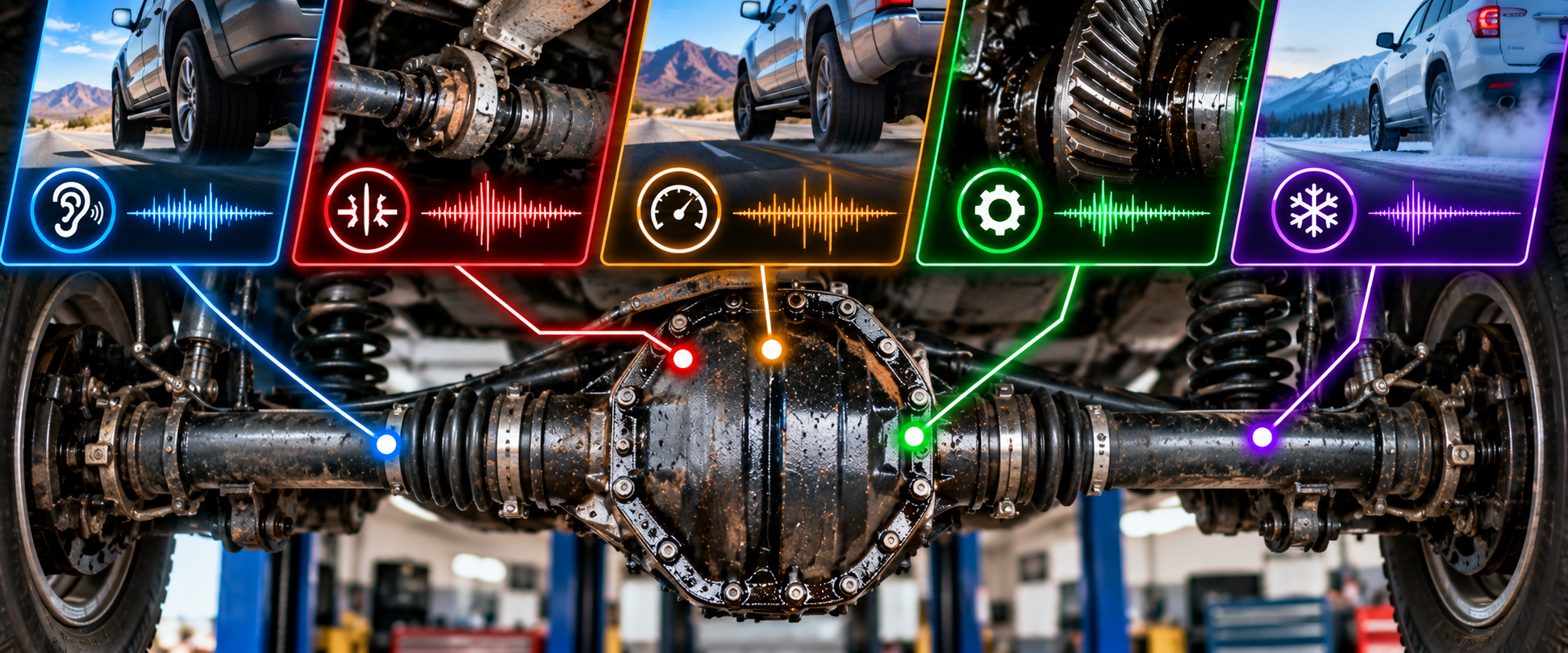
What Your Differential Noise Is Telling You
The kind of noise, and when you hear it, says a lot about which part is wearing. Use this as a guide before your diagnostic:
| What you notice | What it often means |
| Whine or howl while accelerating, rising with speed | Worn ring and pinion gears or a gear setup problem |
| Whir or whine only when you let off the gas | Worn pinion bearings or loose pinion bearing preload |
| Rumble or whir above about 20 mph that won’t go away | Worn carrier bearings (wheel bearings can sound similar) |
| Clunk when you get on or off the gas | Driveline slack: worn U-joints, a loose yoke, or worn gears |
| Clunk or bang only in corners | Broken spider gears or worn limited-slip clutches |
| Chatter or shudder in tight, slow turns | Limited-slip clutches with the wrong or worn-out gear oil |
| A clunk that repeats every few feet | A broken ring or pinion gear tooth. Stop driving. |
Many of these sounds overlap with wheel bearing, tire, and U-joint noise, which is why a hands-on diagnostic matters before any parts are replaced.
Other Signs Your Differential Needs Attention
- Gear oil leaks. Look for dark, thick oil around the differential cover, the pinion seal where the driveshaft connects, or the axle seals near the wheels. Gear oil has a strong, sulfur-like smell.
- A burning smell after towing or a long drive. Overheated gear oil smells scorched and loses its ability to protect the gears.
- Vibration that increases with speed. Often a worn U-joint or driveshaft balance issue, which can damage the pinion seal and bearings if ignored.
- Uneven tire wear or the vehicle pulling in turns, especially on 4x4s and vehicles with locking or limited-slip differentials.
Why West Valley Driving Is Hard on Differentials
Gear oil works hardest when it’s hot, and West Valley summers keep it hot for months. Heat thins and oxidizes the oil over time, which wears bearings and gears faster. Local driving adds more load:
- Towing to Lake Pleasant via Loop 303 or the Carefree Highway, often with a heavy boat on a hot afternoon. Our post on towing a trailer or boat in the Valley covers how to protect your drivetrain on those trips.
- Dirt and desert roads, where dust and water crossings can get past worn seals and contaminate the gear oil.
- Lifted trucks and larger tires, which add load to the ring and pinion, especially when the gearing hasn’t been changed to match.
- Stop-and-go traffic on Loop 101, Camelback Road, and around Westgate on event days.
Work trucks and 4x4s that see these conditions regularly are the ones we most often see with worn differentials.
Is It Safe to Drive With a Bad Differential?
It depends on the symptom:
- A mild whine or hum: Usually safe to drive short distances, but get it checked soon. Bearing and gear wear speeds up once it starts.
- A small leak: Check the fluid level and have it inspected. Running low on gear oil can ruin a differential quickly.
- Grinding, banging, a rhythmic clunk, or a burning smell: Stop driving. A differential that locks up can cause a loss of control.
If your vehicle isn’t safe to drive, call us at (623) 600-8661. We offer free towing (up to a $100 value) to our Glendale shop with any major repair.
How Often Should Differential Fluid Be Changed?
Intervals vary widely by vehicle, so start with your owner’s manual. Most manuals list a normal schedule and a severe-service schedule, and towing, extreme heat, and off-road driving are typically counted as severe. For many trucks and SUVs in the West Valley, the severe schedule is the right one to follow.
Using the correct fluid matters just as much. Limited-slip differentials often need gear oil with a friction modifier. The wrong oil can cause chatter, noise, and early clutch wear. If your vehicle has a limited-slip or locking differential, make sure the shop knows before any fluid service.
Differential Repair, Rebuild, or Replacement?
The right fix depends on what’s worn and how far the damage has gone:
| Problem | Usual fix |
| Old, low, or contaminated gear oil | Fluid service, plus finding and fixing any leak |
| Leaking pinion, axle, or cover seals | Seal or gasket replacement |
| Worn pinion or carrier bearings | Bearing replacement and proper preload setup |
| Limited-slip chatter | Fluid service with the correct additive, or clutch pack replacement |
| Worn ring and pinion or broken spider gears | Differential rebuild |
| Cracked housing or severe internal damage | Differential replacement |
Early repairs are far less involved than a rebuild. A whine caught while it’s still a bearing problem is a much smaller job than one that has damaged the gears. See our differential repair service page for more on how we handle front, rear, open, limited-slip, and locking differentials.
Differential Repair at Pro-Tech Transmissions in Glendale
Pro-Tech Transmissions is a family-owned shop at 5408 W Camelback Rd #2, Glendale, AZ 85301, near 55th Avenue and Camelback Road. We work on differentials, transmissions, and transfer cases for drivers in Glendale, Peoria, Surprise, Sun City, Avondale, Goodyear, and across the West Valley.
- Free diagnostic so you know what’s actually wrong before you spend anything
- Free towing (up to a $100 value) with any major repair
- Financing available on major repairs, upon approval
- 5% off (up to $100) with our current coupon
- We honor most extended warranties, so bring your paperwork
Hours: Monday through Friday, 8:00 AM to 5:00 PM, and Saturday, 8:00 AM to 12:00 PM.
If your truck, SUV, or car is whining, clunking, or leaking gear oil, schedule a free diagnostic or call (623) 600-8661.
Differential Problem FAQs
What does a bad differential sound like?
A failing differential usually makes a whine or howl that changes with vehicle speed, a whir when you let off the gas, a rumble at highway speeds, or a clunk when you get on and off the throttle or turn a corner. The type of noise and when it happens help pinpoint which part is worn.
Why does my differential whine only when I let off the gas?
A whir or whine that shows up only while decelerating usually points to worn pinion bearings or loose pinion bearing preload, rather than the ring and pinion gears themselves. Catching it early can keep the problem from spreading to the gears.
Is it safe to drive with a whining differential?
A mild whine is a warning sign, not an emergency, but it should be checked soon because worn bearings and low fluid get worse quickly. Stop driving and arrange a tow if you hear grinding, a rhythmic clunk every few feet, or loud banging, or if you smell burning gear oil.
Why does my truck clunk when I get on or off the gas?
A clunk when you accelerate or let off the throttle usually comes from slack in the driveline, such as worn U-joints, a loose yoke, or worn gears in the differential, transfer case, or transmission. A diagnostic can find which component is moving.
Why does my limited-slip differential chatter when I turn?
Limited-slip chatter in tight turns is most often caused by gear oil with the wrong friction properties for the clutch packs, such as missing friction modifier or old, worn-out fluid. A fluid service with the correct lubricant often fixes it. If it doesn’t, the clutch packs may be worn.
How often should differential fluid be changed in Arizona?
Check your owner’s manual for the severe-service interval, because towing, extreme heat, and off-road driving are typically listed as severe conditions. Trucks and SUVs that tow or drive in West Valley summer heat often need differential fluid changed sooner than the normal schedule suggests.
Does Pro-Tech Transmissions repair differentials in Glendale?
Yes. Pro-Tech Transmissions repairs, rebuilds, and services front, rear, open, limited-slip, and locking differentials at 5408 W Camelback Rd #2 in Glendale, near 55th Avenue. The diagnostic is free, and free towing (up to a $100 value) is available with any major repair.